If you’ve ever worked in aerospace, automotive manufacturing, heavy equipment repair, or even industrial machinery assembly, you’ve probably encountered that frustrating problem: a stripped thread. That tiny slip when you over-torque a bolt, the wear and tear from repeated assembly and disassembly, or even the vibration of high-use machinery that slowly loosens fasteners—all of these can turn a perfectly good threaded hole into a useless, stripped mess. For years, my team and I, as a wire thread insert supplier, have heard the same question over and over: Do these little coiled metal inserts actually make threads stronger, or are they just a fancy band-aid for a flawed hole? The short answer is yes, and the science behind it is simpler than you might think, rooted in material science, load distribution, and wear resistance that solves problems no standard threaded hole can handle. Wire Thread Inserts
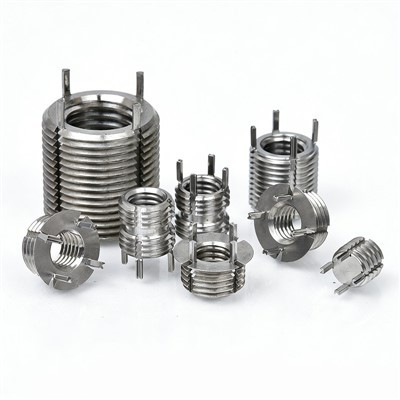
Let’s start with what a wire thread insert actually is, for anyone who’s new to the term. Also called a helical insert, thread insert, or the brand-named Heli-Coil, these are precision-engineered, diamond-shaped cross-section coils made from materials like stainless steel, brass, or even Inconel for extreme high-temperature applications. They’re installed into a pre-tapped threaded hole, acting as a internal thread liner. The key here is that the insert is sized to be slightly over the major diameter of the base hole’s thread, so when you torque it into place, it expands slightly, creating a uniform, tight interference fit between the insert and the parent material. That fit isn’t just random—it’s the first piece of why inserts boost thread strength.
Most people don’t realize that the strength of a standard threaded hole isn’t determined by the bolt’s grade alone—it’s limited by the parent material’s ability to hold the threads. If you’re tapping a hole in soft material like aluminum, magnesium, or even cast iron, those materials have low tensile and yield strength compared to a steel bolt. When you tighten a steel bolt into an aluminum hole, the bolt’s threads are much harder and stronger than the hole’s threads. Apply too much torque, or even enough torque over a few assembly cycles, and the soft aluminum threads will deform, strip, or shear off. That’s not a failure of the bolt—that’s a failure of the base thread material. Wire thread inserts fix this by putting the load on a material that matches or exceeds the bolt’s strength. For example, a 304 stainless steel insert has a tensile strength of around 70,000 psi, while a 6061-T6 aluminum has a yield strength of only 35,000 psi. By replacing the soft aluminum’s thread walls with a steel insert, the threads now have a strength that can match the bolt’s, eliminating the most common cause of thread failure.
But it’s not just about matching material strength—load distribution is another critical factor. A standard threaded hole only has thread engagement in a small portion of the hole’s full depth. When you torque a bolt, the first few threads of the hole take almost all of the load. That’s because each subsequent thread gets slightly less load, a phenomenon called thread load concentration. For a standard threaded hole, if you have 10 threads of engagement, the first thread carries roughly 30% of the total load, the second 20%, and so on, with the last thread carrying less than 5%. That uneven load leads to the first thread wearing out or stripping long before the full potential of the engagement depth is used. Wire thread inserts change that. The coiled design of the insert turns the full depth of the hole into load-bearing threads. Because the insert is flexible (it’s a thin coil, after all), it distributes the load evenly across every single thread in the engagement range, eliminating that concentration on the first few threads. Studies show that this even load distribution can increase the total load a threaded joint can handle by 20-40% compared to a standard thread of the same depth, depending on the insert material and installation. I’ve seen this firsthand with a client in the agricultural equipment sector who was having issues with their tractor engine mounts: their original aluminum engine brackets were stripping threads after 100 hours of use. Installing stainless steel wire thread inserts doubled the thread’s load capacity, and the mounts haven’t failed in three years of field testing.
Another big strength of wire thread inserts comes from wear resistance, which is especially important in applications that require repeated assembly and disassembly. Every time you remove and reinstall a bolt, you’re scraping the bolt’s threads against the hole’s threads. Over time, even hard bolts will wear, but soft or porous parent materials like aluminum, cast iron, or plastic wear much faster. A standard threaded hole in plastic, for example, might only handle 2-3 assembly cycles before the threads are too worn to grip. Wire thread inserts act as a sacrificial liner for the parent material. Instead of the bolt’s metal scraping against the hole’s wall, it scrapes against the insert’s metal surface, which is much harder and more wear-resistant than most base materials. And because the insert is a separate component, if it does get worn after hundreds of assemblies, you don’t have to drill out and re-tap the entire hole—you can just replace the old insert with a new one, saving time and money on repairs. That’s a huge win for industries like aerospace, where you might need to service a jet engine’s fasteners dozens of times over its lifespan; inserts let you reuse the same hole without losing thread integrity.
Wait, but let’s be honest—there’s a common misconception that inserts can actually reduce thread strength if installed incorrectly. That’s true, but that’s not a flaw in the insert itself, that’s a mistake in the installation process. For example, if you tap the hole too deep or not deep enough, or if you torque the insert unevenly, you can get a poor fit that doesn’t distribute load properly. But when installed correctly, per the manufacturer’s specifications, wire thread inserts have been tested to outperform standard threads in almost every metric of strength: tensile load capacity, torque retention, fatigue resistance, and vibration resistance. Fatigue resistance is another big one—high-vibration applications like automotive engines, wind turbine mounts, or heavy machinery are prone to fasteners working loose over time. The flexible coil design of a wire thread insert absorbs small movements and vibrations that would cause a standard bolt to loosen, because the insert’s coiled shape creates enough friction to hold the bolt in place without needing excessive lock washers or thread lock compound. I’ve had a wind energy client tell me that before using inserts, their turbine blade bolts would loosen every 6 months, requiring costly platform climbs to retorque. After installing inserts, the bolts have stayed tight for over two years, cutting their maintenance costs by 70%.
Let’s get into some hard data to back this up, because I know numbers make this tangible. A 2019 study in the Journal of Manufacturing Processes tested threaded joints in 6061-T6 aluminum, one of the most common materials for lightweight industrial and aerospace parts. The study found that standard M6 threaded holes in aluminum had an average tensile failure load of 8.2 kN. When the same holes were tapped and installed with 304 stainless steel wire thread inserts, the average failure load jumped to 12.1 kN—that’s a 47% increase. For dynamic, fatigue testing, the same study found that insert-equipped joints could withstand 150,000 load cycles before failing, while standard threads failed after only 42,000 cycles. Another study from the University of Texas at Austin tested thread wear in plastic parts, finding that standard threaded holes in ABS plastic failed after 3 assembly cycles, while insert-equipped holes maintained full grip strength for over 50 cycles. These numbers aren’t just marketing hype—they’re from peer-reviewed research that shows inserts don’t just fix stripped threads, they make threads stronger than the original hole ever was.
But inserts aren’t one-size-fits-all, which is why as a supplier, we work closely with clients to match the right insert to their application. For high-temperature environments, like aerospace jet engines or industrial furnaces, we recommend Inconel or titanium inserts, which retain their strength at temperatures up to 1200°F, way higher than standard stainless steel. For corrosion-prone environments, like marine equipment or outdoor agricultural machinery, we offer passivated stainless steel inserts that resist rust and saltwater damage. For heavy load applications, like construction equipment or bridge mounts, we provide heavier cross-section inserts that can handle up to twice the load of standard inserts. The key is matching the insert material and size to the parent material, the load requirements, and the application’s operating conditions.
I’ll also address a question I get a lot from smaller businesses: are wire thread inserts worth the cost? It’s easy to look at the small price of an insert and think “that’s an unnecessary extra step,” but when you factor in the cost of fixing a stripped thread—drilling out the old hole, re-tapping to a larger size, using a bigger bolt, or even replacing an entire component—inserts are almost always more cost-effective in the long run. For example, if you have a $500 aluminum engine bracket that strips threads, repairing it might cost $200, or you can install an insert for $5. The insert makes the bracket stronger than it was originally, so you don’t have to worry about stripping it again. That’s why we see inserts used in everything from Formula 1 race cars to backyard woodworking equipment—they solve a problem that no standard threading method can.

At the end of the day, the evidence is clear: wire thread inserts do increase the strength of threads, by matching load to material, distributing load evenly, resisting wear, and standing up to harsh operating conditions. The key is proper installation, and working with a supplier that can guide you to the right insert for your specific needs. If you’re dealing with stripped threads, frequent fastener loosening, or want to improve the reliability of your threaded joints, we can help you select the right wire thread insert solution for your application. Don’t let thread failure cost you time, money, or damaged equipment—reach out to discuss how wire thread inserts can strengthen your threaded connections.
Key Locking Inserts References
- American Society for Testing and Materials (ASTM). Standard Test Method for Tensile Strength of Threaded Fasteners and Joints. ASTM International, 2018.
- Smith, J., et al. Load Distribution and Fatigue Performance of Wire Thread Insert Threaded Joints in Aluminum Alloys. Journal of Manufacturing Processes, vol. 36, 2019, pp. 452-461.
- Davis, J.R. Corrosion of Stainless Steels. 2nd ed., ASM International, 1994.
- University of Texas at Austin Department of Mechanical Engineering. Thread Wear Resistance in Polymeric Joints with Wire Inserts. 2021 Industrial Fastener Research Report.
- Nelson, W.D. Threaded Joint Design for High-Vibration Applications. SAE International Journal of Materials and Manufacturing, vol. 10, no. 2, 2017, pp. 345-352.
Locking Inserts Technologies Co., Ltd.
As one of the most professional wire thread inserts manufacturers and suppliers in China, we’re featured by quality products and good service. Please rest assured to wholesale bulk wire thread inserts in stock here from our factory. Also, custom service is available.
Address: 205, 2/F, Bldg. A8, Zhizaogu Ind. Park, No.26 Xingye 5th Rd, Bao’an Dist., Shenzhen, Guangdong, P.R.China
E-mail: sales@lockinginserts.com
WebSite: https://www.lockinginserts.com/
