If you’ve ever stood in a lab watching cell cultures grow or fermentation reactions bubble steadily in a glass vessel, you’ve likely encountered a batch laboratory bioreactor—even if you didn’t know its name. As a supplier focused exclusively on lab-scale bioreactors, I work with researchers every week who are just starting out with bioprocessing, and many of them come in confused about what makes a batch bioreactor different from other types, and why it’s such a workhorse in academic and industrial R&D. Let’s break this down, no jargon overload, just the practical stuff we see every day. Laboratory Bioreactor
First, let’s start with the basics: what “batch” means in bioreactor terms. A batch process is closed by design, at least at the start and end of a run. Here’s how it works: you load all the raw materials into the bioreactor vessel right away—this could be growth media, seed cells, enzymes, or microbial inoculants. Then you seal it, set your parameters (temperature, pH, agitation speed, oxygen flow), and let the reaction run its course without adding or removing anything mid-cycle. When the reaction is done—whether that’s after 24 hours for a bacterial culture or two weeks for mammalian cell production—you drain the entire contents to harvest your product. There’s no continuous feed, no constant removal of spent media, no shuffling ingredients in and out while the process is active. That’s the core of a batch lab bioreactor, and it’s different from fed-batch (where you add nutrients gradually) or continuous bioreactors (where input and output happen nonstop).
Why do researchers stick with batch systems for lab work, instead of switching to other setups that sound more high-tech? It boils down to simplicity, consistency, and cost. For small-scale experiments, which is where most academic labs and early-stage biotech teams operate, batch bioreactors are low-fuss. You don’t need complex plumbing for feeding or harvesting, you don’t have to calibrate sensors for continuous flow, and the math to scale results up (or down) is far more straightforward. When I talk to a grad student testing a new protein expression strain for the first time, they don’t want to spend a week troubleshooting a continuous setup—they want to load their sample, hit “start,” and get reliable, repeatable data by the end of the day. That’s exactly what a batch lab bioreactor delivers.
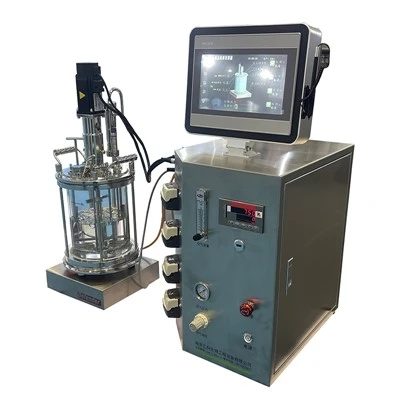
Let’s get into the components that make a lab batch bioreactor work, because this is where new users often get tripped up. Unlike industrial bioreactors that are massive steel tanks, lab-scale units are usually small—from 1 liter up to, say, 100 liters, with the most common sizes being 2L, 5L, and 10L for R&D work. They’re typically made of borosilicate glass (so you can visually monitor the culture, which is a big plus for spotting contamination or abnormal growth) or stainless steel for more rigorous, repeated use. The key parts every lab batch bioreactor has:
First, the vessel itself, sealed with a headplate that holds all the sensors and ports. The most critical sensors are pH probes and dissolved oxygen (DO) probes—cells need a specific pH to grow, and oxygen is non-negotiable for aerobic cultures. Agitation systems, usually impellers inside the vessel, mix the media and keep oxygen evenly distributed; if your impeller is too slow, cells at the bottom of the vessel don’t get enough oxygen, and if it’s too fast, you can shear delicate mammalian cells to death. Temperature control is another big one: most cultures need to stay between 20°C and 37°C, so the bioreactor jacket (a layer around the vessel) circulates water from a heated/cooled bath to maintain consistent temps. There are also ports for adding samples, adjusting pH, or taking small aliquots for testing without breaking the seal—important for tracking growth over time without risking contamination.
Now, the common uses for batch lab bioreactors, because that’s what makes them indispensable. We sell these units to three main groups: academic researchers, small biotech startups, and contract research organizations (CROs). Academics use them for everything—testing new microbial strains for biofuel production, growing monoclonal antibodies for cancer research, or studying how viral vectors replicate for vaccine development. I worked with a team at a university last year that used 3L batch bioreactors to optimize a yeast strain that breaks down agricultural waste into bioplastics; they ran 12 separate batch runs to tweak pH and agitation, and the simplicity of the setup let them iterate quickly.
Small biotechs, on the other hand, use batch bioreactors for pre-clinical work. If a startup is developing a new gene therapy, they’ll use batch bioreactors to produce the viral vectors needed for early animal trials. The batch format lets them produce a precise, measurable amount of product every time, which is critical for regulatory testing—regulators love consistent, well-documented batch processes because it’s easy to trace where something went wrong if a trial fails. CROs also rely heavily on batch lab bioreactors, since they often handle multiple client projects at once; a batch system lets them run different cultures for different clients without cross-contamination, as long as they follow proper sterilization protocols.
Wait, let’s talk about sterilization, because that’s make or break for batch bioreactors. If your media or vessel isn’t sterile, you’ll get bacterial or fungal contamination that ruins your entire run. Lab batch bioreactors are designed for easy sterilization—most glass vessels can be autoclaved, and stainless steel units can be sterilized in place (SIP, or sterilization in place) without taking the unit apart. Some newer models even have disposable single-use vessels, which are pre-sterilized, so you don’t have to autoclave anything at all—perfect for labs that are short on time or working with high-containment pathogens. That’s a relatively recent innovation, but it’s exploded in popularity over the last five years, especially for teams that don’t have a dedicated sterile processing tech on staff.
Now, what are the limitations of batch lab bioreactors? It’s not all perfect. Because you add all nutrients at the start, cultures often hit a “death phase” faster than in fed-batch systems, because nutrients get used up and waste products build up. For example, E. coli cultures in a batch bioreactor will grow exponentially for a day, then crash as the glucose runs out and lactic acid accumulates. If you need a high yield of product that requires extended growth, a fed-batch setup might be better, but for most lab-scale work, that limited growth window is acceptable. Also, batch runs are “one and done”—you can’t just keep going; if you want another run, you have to load and sterilize a new vessel, which adds time. But for small batches, that tradeoff is worth it for the simplicity.
As a supplier, I hear a lot of customers mix up lab batch bioreactors with other lab equipment, so let’s clarify: a shaker flask is not a bioreactor. Shaker flasks are open (or loosely sealed), so they’re prone to contamination, and you can’t control pH or dissolved oxygen precisely—you just shake them and hope for the best. A batch lab bioreactor is a closed, controlled system, so you get reproducible, quantitative data that you can’t get from a shaker flask. That’s the biggest difference, and why bioreactors are worth the investment for anyone doing serious R&D.
Let me give a real example of a time a customer came to us after learning this the hard way. A grad student at a mid-sized university called us last year, frustrated because his shaker flask cultures kept giving inconsistent results—one run would have twice the cell density as the next, and he couldn’t figure out why. We recommended a 5L batch lab bioreactor, and within a month, his data was consistent. The bioreactor let him set a fixed 37°C, 70% dissolved oxygen, and 7.2 pH, so every run was identical. He told us that without that, he would have had to delay his thesis work by another six months. That’s the kind of impact these small bioreactors have—they’re not just pieces of equipment, they’re tools that move research forward.
Another common question we get: what size batch bioreactor do I need? That depends on your work. If you’re doing cell-based assays in 96-well plates, a 100mL mini batch bioreactor might be all you need, to scale up those plate results. If you’re producing enough product for a small animal trial, a 2L or 5L unit is standard. For early-stage clinical trials, you’d move to larger lab-scale units, but even there, batch processes are still common for early phase work. The key is to match the bioreactor size to your volume needs—too big, and you’re wasting media; too small, and you can’t produce enough product.
We also work with customers who are upgrading from older bioreactors to newer batch models. The biggest improvements we’ve seen over the last decade are in automation and data tracking. Modern batch lab bioreactors can connect to laptops or cloud software, so you can monitor your run in real time from across the lab, set alerts if pH drops too low, and export all your run data for your papers or grant applications. Ten years ago, you’d have to write down every parameter manually, which left room for human error; now, everything is logged automatically, which makes it way easier to replicate results and publish. That’s been a game-changer for researchers, who are under more pressure than ever to produce solid, reproducible data.
Let’s address a misconception some new customers have: batch bioreactors are only for microbial cultures. No way—they work for mammalian cells, plant cells, enzymes, even algae. We’ve sold batch bioreactors to a team that’s growing tobacco cells to produce biopharmaceuticals, and another that’s growing spirulina for nutritional supplements. The only time a batch setup isn’t ideal is when you need to produce a very high volume of product continuously, or when your process requires feeding nutrients at specific intervals. For 90% of lab-scale bioprocessing work, though, batch is perfect.
Now, if you’re reading this and you’re in the market for a batch lab bioreactor, what should you look for? First, match the size to your needs, as I mentioned. Second, check the control system—does it have intuitive software? You don’t want to spend hours learning how to operate a bioreactor when you could be running experiments. Third, think about sterilization: glass vessels are great if you want visual monitoring, stainless steel is better for repeated runs, and single-use vessels are perfect for avoiding cross-contamination. Fourth, make sure the supplier offers technical support—bioreactors can have sensor issues or calibration problems, and being able to call someone who knows your equipment is way better than trying to troubleshoot alone.
At the end of the day, a batch laboratory bioreactor is more than just a tank with a few knobs. It’s a controlled, closed system that lets researchers turn raw materials into valuable products, test hypotheses, and make breakthroughs that can lead to new medicines, better biofuels, or more sustainable materials. As a supplier, we see that every day—from the first time a grad student gets consistent cell counts to a startup that uses their bioreactor to file a patent for a new therapy. It’s rewarding to be part of that process.
Laboratory Bioreactor If you’re ready to learn more about how a batch laboratory bioreactor can fit your research, or if you have questions about sizes, features, or customization, we’re here to help. We work with teams across academic, biotech, and CRO settings to find the right bioreactor for their needs, no matter how small or specialized your project is. Don’t hesitate to reach out to start a conversation about your requirements.
References
- Lee, S. Y. (1996). Advanced fermentation and cell culture systems for secondary metabolite production. Trends in Biotechnology, 14(5), 198-205.
- Blank, L. M., & Portner, R. (2009). Toolbox for advanced bioprocess monitoring. Current Opinion in Biotechnology, 20(4), 457-464.
- Eibl, R., & Eibl, D. (2018). Single-use bioreactors: an overview. Advances in Biochemical Engineering/Biotechnology, 162, 1-28.
- Freshney, R. I. (2011). Culture of Animal Cells: A Manual of Basic Technique and Specialized Applications (7th ed.). Wiley-Liss.
- Stanbury, P. F., Whitaker, A., & Hall, S. J. (2017). Principles of Fermentation Technology (3rd ed.). Butterworth-Heinemann.
Nanjing Tianhong Bioengineering Equipment Co., Ltd.
As one of the most professional laboratory bioreactor manufacturers and suppliers in China, we’re featured by quality products and good price. We warmly welcome you to buy customized laboratory bioreactor made in China here from our factory. If you have any enquiry about pricelist, please feel free to email us.
Address: No.8 Xingshi South Road, Shiqiu Sub-district, Lishui District, Nanjing City, Jiangsu Province, P.R. China
E-mail: 13951637999@163.com
WebSite: https://www.njth-bio.com/
